
Hello everyone—Shayne here. I want to walk through a recruitment conversation I received, because knowing how to build a website or use technology does not make anyone immune to a convincing pitch.
This is a practical guide to how to identify a fake job posting, using my own messages as a case study. It is also about knowing when to stop, ask a better question and check the answer somewhere the person contacting you does not control.
01 / THE OPPORTUNITYIt started with something ordinary.
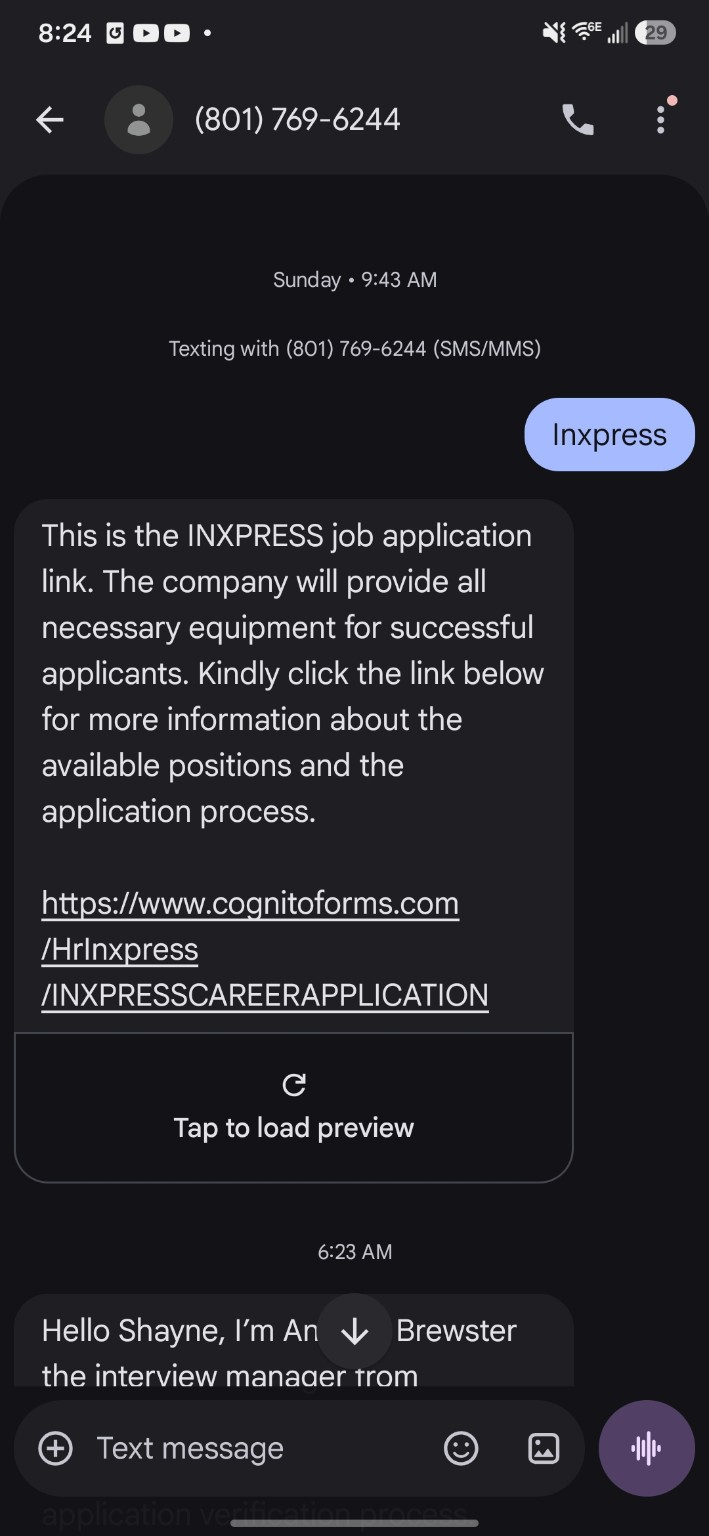
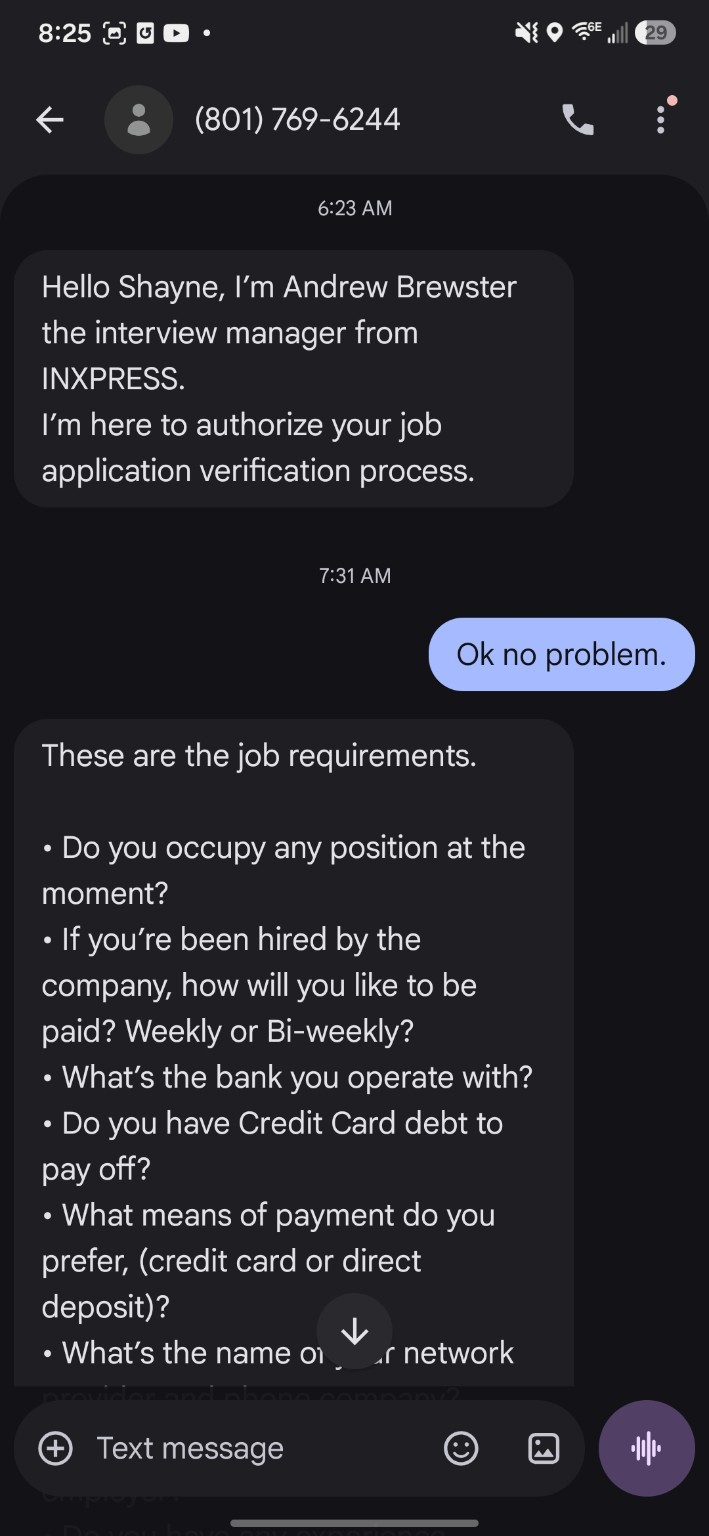
The opportunity was presented as a data-entry position. The conversation included an application link and a promise that the company would provide equipment. Another message introduced the sender as an interview manager from INXPRESS and described an application verification process.
That combination can feel familiar: a company name you can search, an online form and someone apparently guiding you through hiring. I replied and answered questions. You can see that in the screenshots. I am not presenting this as a story where every warning was obvious from the first message.
The first question is not simply, “Does this company exist?” It is, “Can this company independently confirm this particular person, role and application process?” Those are different checks.
02 / THE RED FLAGWhy was a job interview turning into a conversation about my debt?
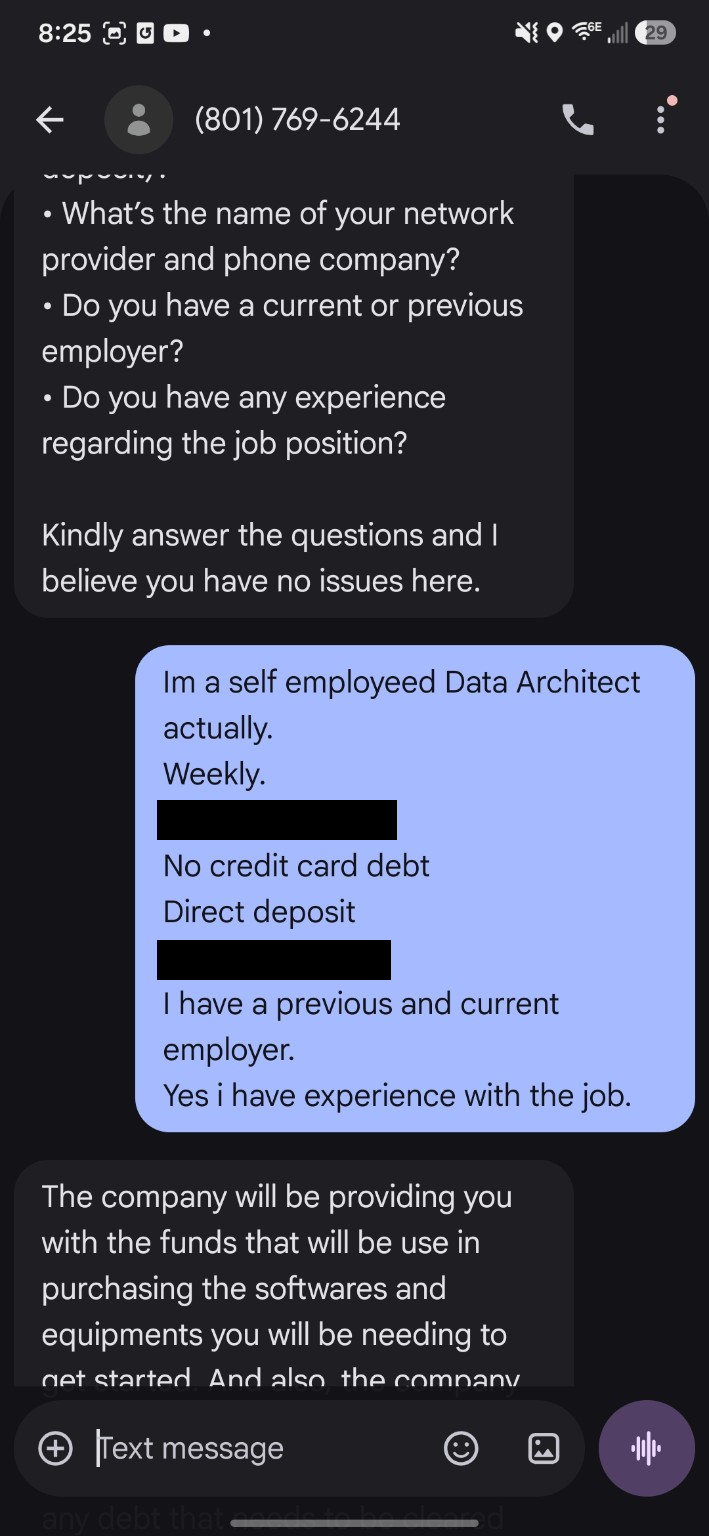
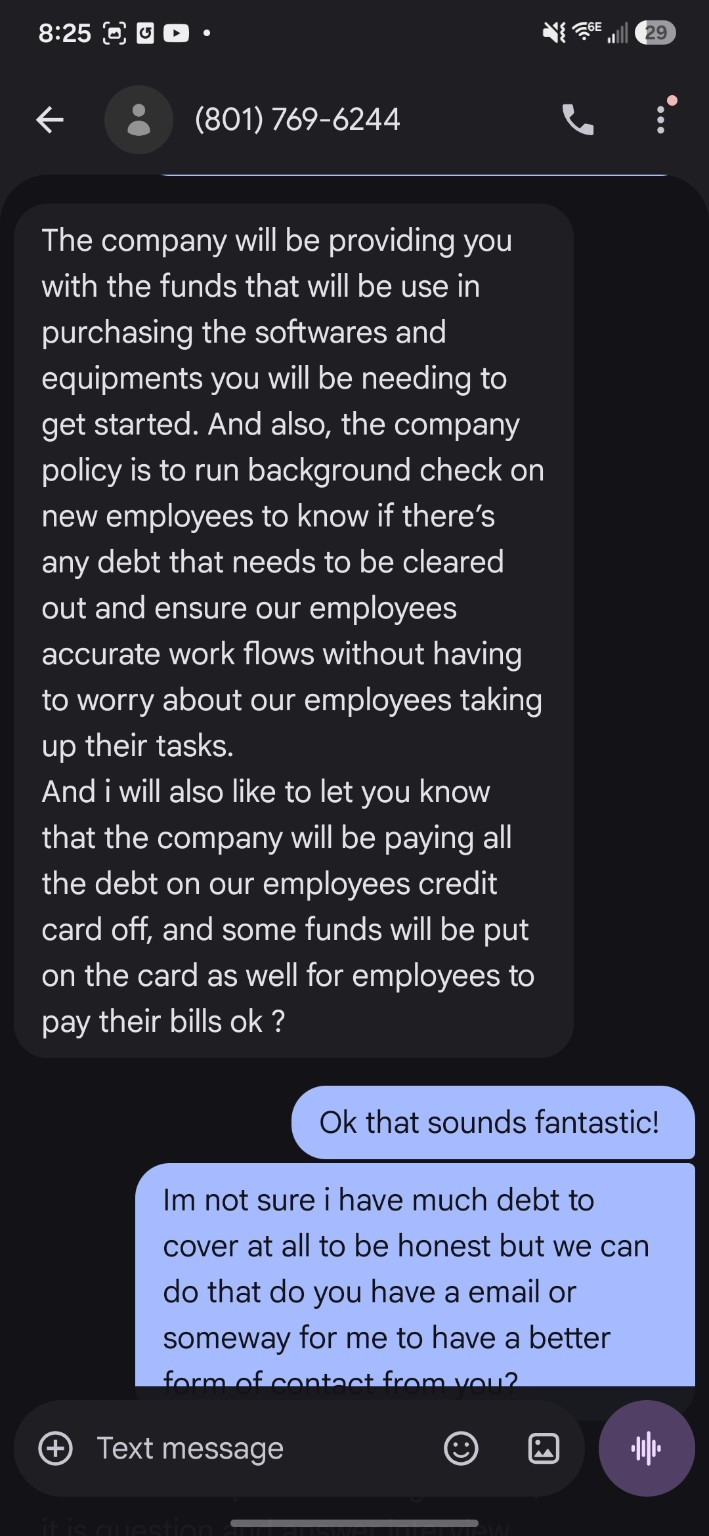
The questions mixed ordinary screening topics—employment, experience and pay frequency—with requests for my bank provider, phone carrier and whether I had credit-card debt. Then came the larger claim: the company would provide equipment funds, pay off employees’ credit-card debt and put additional money on the card for bills.
“the company will be paying all the debt on our employees credit card off”
Excerpt from the received message; see screenshot 04 below.
Employer-provided equipment is not inherently suspicious. A debt-payoff promise, personal financial questions and an unverified sender together demand a much more careful check. The offer is shifting attention from the work to immediate financial relief.
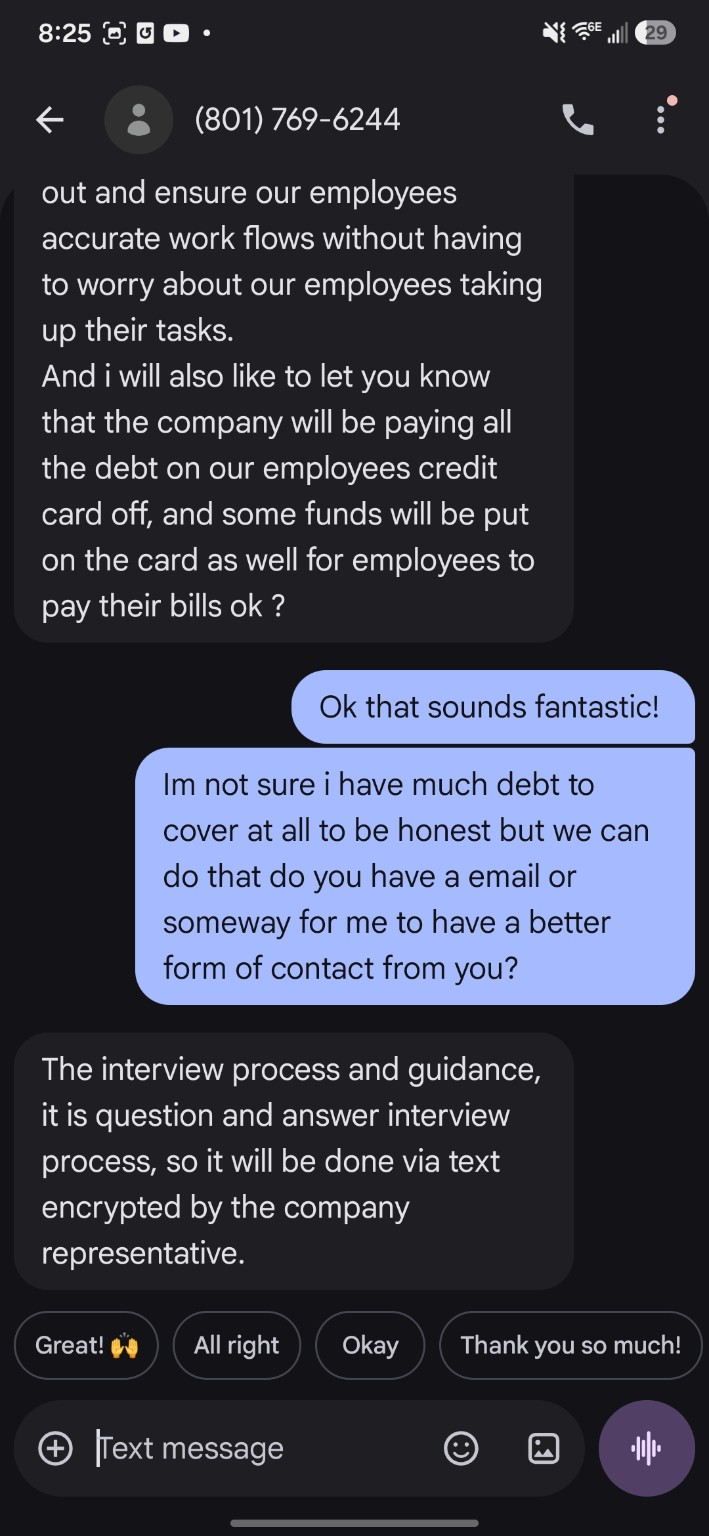
I asked for an email address or a better way to make contact. The reply described a question-and-answer interview conducted through text, supposedly “encrypted by the company representative.” That statement did not independently verify the sender or explain the security of the conversation.
Equipment funding
Ask who supplies it, how it is delivered and whether an independently verified employer confirms the arrangement.
Personal debt
A promise to clear your card balance needs scrutiny. Do not turn an unverified job conversation into a financial transaction.
No independent confirmation
A claimed name, interview title or encryption claim does not establish authority to recruit.
The FTC describes job scams involving equipment invoices, advance payments and early requests for sensitive information. Its advice is to verify the offer through contact details obtained independently of the recruiter. Read the FTC’s job-scam guidance.
Equipment-purchase scams can also involve a fake check followed by instructions to spend or forward money. Money appearing in an account does not make that arrangement safe; the payment can fail later. The FTC explains this pattern. The screenshots here do not show a check, completed payment or specific purchase instruction. I am explaining a known risk, not claiming those later steps happened in this conversation.
03 / THE INVESTIGATIONConnect the dots. Then check the connection.
I looked into the company’s public presence and contacted InXpress. The response I received was a request to send the information to IT so it could investigate. That is the current follow-up—not a written determination reproduced in this article.
For this article, the company’s published contact details were also checked directly. InXpress’s official contact page lists 801-495-7894. The sender displayed in my messages is 801-769-6244.
801-769-6244
Sender identity and affiliation unverified801-495-7894
Official contact page · checked October 27, 2026The shared 801 area code can make the contact feel geographically consistent. The rest of the numbers differ. Neither the shared prefix nor that difference settles the question: companies can have many legitimate numbers, and an area code is not an employment credential.
The number is preserved here as it appeared in my conversation. It is not proof of a subscriber’s identity, physical location or responsibility. The FTC warns that displayed caller information can be falsified; these screenshots do not establish whether spoofing occurred in this case. FTC guidance on misleading caller ID.
The application link deserves the same scrutiny.
The first screenshot shows a form hosted at cognitoforms.com, with the company name in the path. Cognito Forms is a form-building service. A recognizable hosting service and a company-named form do not, by themselves, prove who created or authorized that form. Legitimate employers also use third-party application tools.
The useful check is whether the employer’s independently verified website or HR team confirms that exact application destination. I have left the supplied link visible in the evidence but have not turned it into an application link in this article.
04 / THE TECHNOLOGY LESSONA website gives you something to investigate.
A good website can explain a business, show its work and give people a reliable route to contact it. It can also be copied. A working contact form, search result or professional-looking page is useful evidence to examine—not a guarantee that the person texting you belongs to that business.
The FBI has documented recruitment impersonation that uses real company information and even the identities of actual employees. Finding a matching name on a professional profile is therefore a lead to check, not the end of the investigation. Read the FBI’s recruitment-impersonation advisory.
- Read the actual domain. A company name in a page title, logo or URL path does not make the site company-owned. Follow the employer’s own published application route or have HR confirm the provider.
- Use search to find independent contact routes. Avoid circling back to the same number or link supplied by the person you are checking. A lack of complaints is not proof of safety.
- Check claims where they originate. If a credential matters, use the issuing organization’s verification service. A logo or certificate image alone does not establish who holds it.
- Use AI to organize questions and compare evidence. Open its sources yourself. Do not treat an AI-generated identity match or confident accusation as proof, and do not upload unredacted applicant records unnecessarily.
A secure connection matters, but HTTPS protects the connection; it does not authenticate a recruiter’s employment. The FBI explicitly warns that criminals can use HTTPS too. FBI guidance on fake job listings.
Technology gives us access to information. Critical thinking determines what we do with it.
Discernment also means avoiding lazy conclusions. A small business can have a simple website. A genuine recruiter may start with a text. An employer may use a third-party application portal. None of those facts alone proves fraud. What matters is whether you can verify the relationship and whether the requested action makes sense.
05 / THE HUMAN FACTORNeeding the opportunity does not make you foolish.
When someone needs work, a promising offer can feel like a way forward. A claim that someone will also take care of their bills can make it harder to step back. That does not make the person unintelligent. It makes the promise emotionally significant.
I want this to help people around Beaumont, Banning, Yucaipa and Redlands, and across Riverside and San Bernardino counties. Job seekers in Rialto, Fontana or Riverside deserve useful checks they can actually perform—not a lecture after something goes wrong.
Give yourself permission to pause. Save the messages. Ask someone you trust to review the offer. Verify the employer before taking the next financial or identity-related step. The FTC recommends getting a second perspective as part of avoiding job scams. FTC: how to avoid a job scam.
You do not need to prove a crime before declining to send information or move money. “I cannot verify this yet” is enough reason to wait. Keep looking for work; just keep verification separate from how much you want this particular offer to be real.
What should you give a potential employer?
Think about the stage, the purpose and the destination. Initial screening is different from setting up payroll after a verified offer. Requirements vary by role and employer; an unusual request should have a clear explanation and an independently confirmed process.
Information that helps assess your fit
A professional name, contact email or phone, general location, relevant work history, skills, availability, résumé and public portfolio or credential links. Share reference contact details with those people’s permission. Keep account numbers and unnecessary identity documents off your résumé.
Sensitive information with a specific purpose
Payroll banking details, tax information, identity or work-authorization documents and some background-check information may be needed through an established process. Confirm the employer, the reason and the exact portal or secure delivery method first. A logo on an uploaded form is not that confirmation.
Keep control of your accounts
Do not give a recruiter your bank password, card PIN, email password, recovery codes or one-time sign-in codes. If a verified application service uses a code, enter it yourself on that service. A recruiter does not need to log into your personal accounts to assess your qualifications.
The FTC warns specifically about requests for Social Security numbers, driver’s licenses or bank-account details before a genuine interview and hiring process. Read its advice on early information requests.
Even less sensitive details can help someone tailor a later message. Knowing your bank or carrier is not the same as having account access, but you still do not owe an unverified recruiter that information. In my published screenshots, I covered only those two provider names.
A quick check before you take the next step
- Separate the company from the contact. Record the claimed company, role, recruiter name, number, email domain and application address. Do not assume that proving one of them proves all of them.
- Find the employer independently. Locate its established website and contact route. Ask HR to confirm the job or requisition, recruiter and precise application link. A role missing from a careers page is a reason to ask, not automatic proof of fraud.
- Examine the requested action. Pause over debt-payoff promises, upfront equipment payments, instructions to forward money, early identity documents or pressure to share account access.
- Confirm the next channel. Before sending evidence or onboarding documents, verify the exact recipient or portal through that independent company contact. Do not guess a missing character in an email address.
- Keep a record and get another view. Preserve the original messages and job listing privately. Talk through the offer with someone you trust. You can decline while questions remain unanswered.
If you already sent something
Stop further payments or disclosures and preserve the evidence. If money or account access is involved, contact the relevant provider through its official app or published number promptly. Report the suspicious listing to the platform and the company whose name is being used. The FBI provides these steps in its job-scam advisory. You can also report suspected fraud at ReportFraud.ftc.gov or IC3.gov; if identity information was misused, use IdentityTheft.gov for recovery guidance.
The messages, in sequence
These are screenshots I supplied from the conversation. Only my bank provider and wireless carrier names are blacked out. The remaining image pixels were preserved when the redacted copies were exported. Names and numbers in the conversation are claims or displayed identifiers, not independently established identities. Open any image to read it at full size.
Local employers can make verification easier.
If you run a business in the Inland Empire, your website should give applicants a clear route to the real hiring process. Explain where current roles are listed, how you accept applications and how someone can verify an unexpected recruiter message. Make sure your contact channel reaches a person who can respond.
When you send applicants to another provider, link to that exact destination from your established site. Collect only the information needed for the current stage. Give staff a way to route suspected impersonation reports to the right person. The FBI recommends official website job listings, legitimate contact information and a response plan for recruitment impersonation. FBI recommendations for employers.
This is part of the work I care about at The Data Architect: connecting the website, application form and follow-up into a process people can understand. Our Hire workflow walkthrough shows how a branded application page and applicant management fit together. Those tools support a clearer process; no website builder or form platform guarantees that an employer is legitimate.
The point is to stay curious, protect your information and give yourself room to think. A good opportunity should withstand reasonable questions. Your need for work does not take away your right to ask them.