
For Junction Lantern Supper Club, a fictional Barstow dining concept, I would write two possible visits on paper. One guest knows the neighborhood and wants to reserve a table. Another is planning an unfamiliar stop and needs to decide whether the place fits the journey. Those guests can share a website, but the first useful information is different. My opening task would be to make both routes easy to recognize without creating two separate sites.
This is an independent educational study, not a client project or reopening announcement. The concept below is fictional. It shows proposed work, not measured business results.
The part we can put on the record
Victor Valley News reported on January 28, 2020 that Barstow's Idle Spurs Steakhouse had ceased business the previous week. Idle Spurs in Barstow closes its doors for good.
The reported closure involved a family transition. This exercise makes no judgment about that decision and no claim that digital marketing would have changed it. Junction Lantern Supper Club is fictional. Historical reference: January 2020; exact day not established.
A closure or change of use does not tell us whether a website was good or bad. I am not attributing this history to SEO or claiming a different site would have changed it. The useful exercise is to take a customer task from this type of business and work through a fresh design.
The question I would design around
I would give the home page a clear reservation route and a practical plan-your-visit route. The latter would cover service times, parking, accessibility and what the operator can truthfully say about a typical visit. I would avoid inventing an exact meal duration. A traveler could see enough to make a reasonable decision, while a returning guest could go straight to a booking request. Both routes would use the same confirmed hours and contact information.
The proposed feature: A fictional supper-club site separating a visitor's plan-a-stop path from a local guest's reservation path.
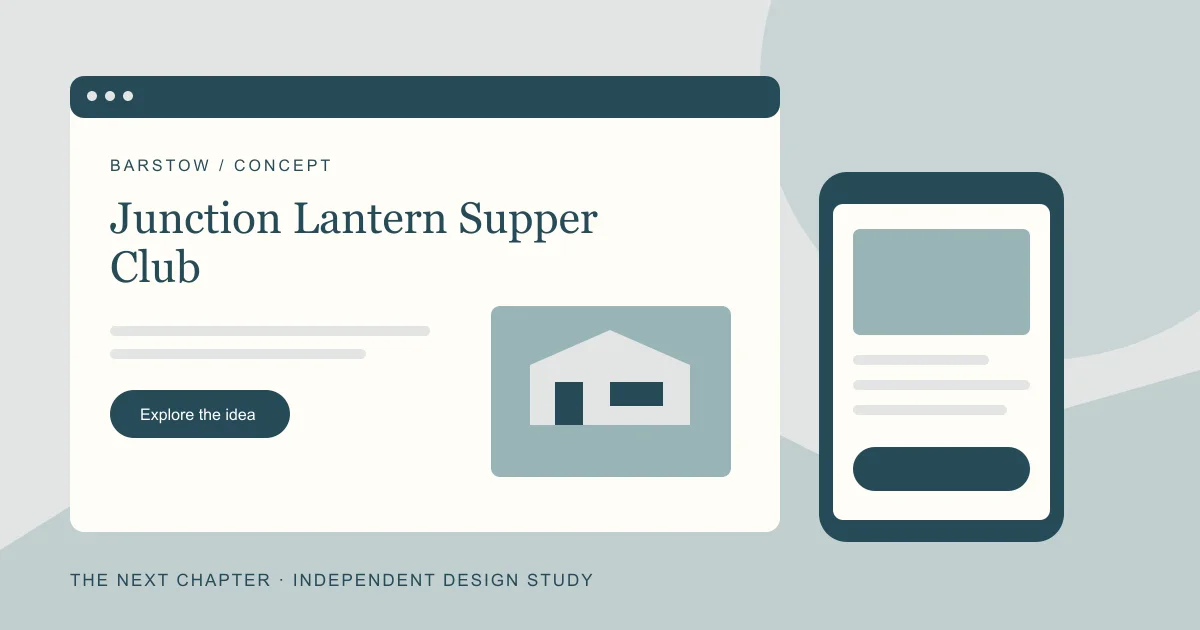
EXPLORE THE WEBSITE CONCEPT
Junction Lantern Supper Club
A proposed digital front door built around a customer task in Barstow.
Travelers making an unfamiliar stop have different information needs from regulars: service hours, reservations, parking and how long a meal may take.
The opening screen would identify the offer, its real location or service area, and the action a customer can actually take. Any hours, prices, availability, or promises would come from the owner before launch.
See how I would check it ↓A fictional supper-club site separating a visitor's plan-a-stop path from a local guest's reservation path.
Give the customer a clear route into this task, explain what is needed, and confirm what happened. A request must never look like a confirmed purchase, appointment, or reservation when it is only an inquiry.
See where it fits in the launch week ↓What would tell us it is useful?
Test whether five unfamiliar users can find hours, directions and booking steps; later measure booking starts and completions.
This is a measurement plan. No traffic, ranking, sales, or conversion results have been collected for this fictional concept.
The first seven days, with a defined finish line
I would scope the first release around the customer task above. The schedule assumes the owner has supplied accurate content, approved the offer, and provided the access needed to launch. Custom integrations or a complex application need their own estimate.
- Day 1 · Establish the facts. Confirm the new concept's offer and audience in Barstow. Collect permission to use its photos and wording. Keep the historical business separate from the new brand.
- Day 2 · Map the decision. Turn the design question into an outline: Travelers making an unfamiliar stop have different information needs from regulars: service hours, reservations, parking and how long a meal may take. Identify what the visitor needs before they act.
- Day 3 · Build the essential pages. Draft a useful home page, an offer or service page, and contact information. Show the Junction Lantern Supper Club identity consistently, with a readable mobile layout.
- Day 4 · Make the task understandable. Prototype and test the proposed feature: A fictional supper-club site separating a visitor's plan-a-stop path from a local guest's reservation path. Use clear instructions, validation, and an honest completion state.
- Day 5 · Check the basics. Test keyboard use, labels, readable text, image sizes, working links, and a phone-sized screen. Check page titles, canonicals, and crawlable navigation.
- Day 6 · Introduce the real site to Google. Verify the appropriate Search Console property, check the sitemap, and inspect an important URL. Requesting a crawl is not a guarantee of indexing.
- Day 7 · Launch and write down the baseline. Complete the main task once from beginning to end, confirm who receives any request, and record what will be measured next: Test whether five unfamiliar users can find hours, directions and booking steps; later measure booking starts and completions.
This is a proposed launch plan for a digital foundation. It does not reopen the historical business, create demand, or promise a particular position in search. Read the detailed seven-day launch guide.
The test matters as much as the layout
At the end of seven days, I would give unfamiliar participants three tasks: find a suitable time, work out how to arrive and explain whether a table has actually been reserved. I would watch where they hesitate and improve those moments. In a live operation, reservation starts and completed bookings would be separate measurements. A pleasant story about a restaurant should lead to an equally clear next step for the person trying to visit it.
Test whether five unfamiliar users can find hours, directions and booking steps; later measure booking starts and completions.
A professional web designer should be able to explain these tradeoffs. If the task needs changing data, rules, or a more complex workflow, a software engineer or web application developer may be part of the build. The useful question is whether the work makes the customer's next step clearer and the business's follow-through dependable.
Carry the idea into your own next chapter
The repeatable part is the process: establish the facts, identify a real customer task, build the smallest complete version, test it, and measure what happens. The details should change with the business. For Barstow, the lesson in this study is: Travelers making an unfamiliar stop have different information needs from regulars: service hours, reservations, parking and how long a meal may take.
Start with Google Search Console · Understand sitemaps and indexing · Read the regional study.