
I would build Riverlight Picture House around a very ordinary Blythe evening: someone has a little free time and wants to know what is happening next. This cinema is an invented concept, not an announced reopening. The first screen would answer a dated question before asking visitors to enjoy a long brand introduction. An event that looks attractive but leaves its date uncertain is not yet useful to the person planning the evening.
This is an independent educational study, not a client project or reopening announcement. The concept below is fictional. It shows proposed work, not measured business results.
The part we can put on the record
The BigScreen Cinema Guide reported an August 29, 2010 closing date for All Star Cinemas in Blythe; Cinema Treasures records that closure. Blythe, CA: All Star Cinemas and Entertainment Center to Close August 29, 2010 — The BigScreen Cinema Guide.
This is a historical cinema closure. The fictional picture house is a design exercise, with no announced reopening or claim about the building’s current use. Historical reference: 2010-08-29.
A closure or change of use does not tell us whether a website was good or bad. I am not attributing this history to SEO or claiming a different site would have changed it. The useful exercise is to take a customer task from this type of business and work through a fresh design.
The question I would design around
The main design decision would be a calendar that can also be read as a simple list. Every proposed screening would have its own page with the date, start time, format, and ticket-options area. I would separate the venue description from those changing events. That keeps a beautiful picture-house story from becoming the accidental source of truth for a schedule that needs regular attention.
The proposed feature: Date-first screening calendar with individual event pages and clearly separated proposed venue information.
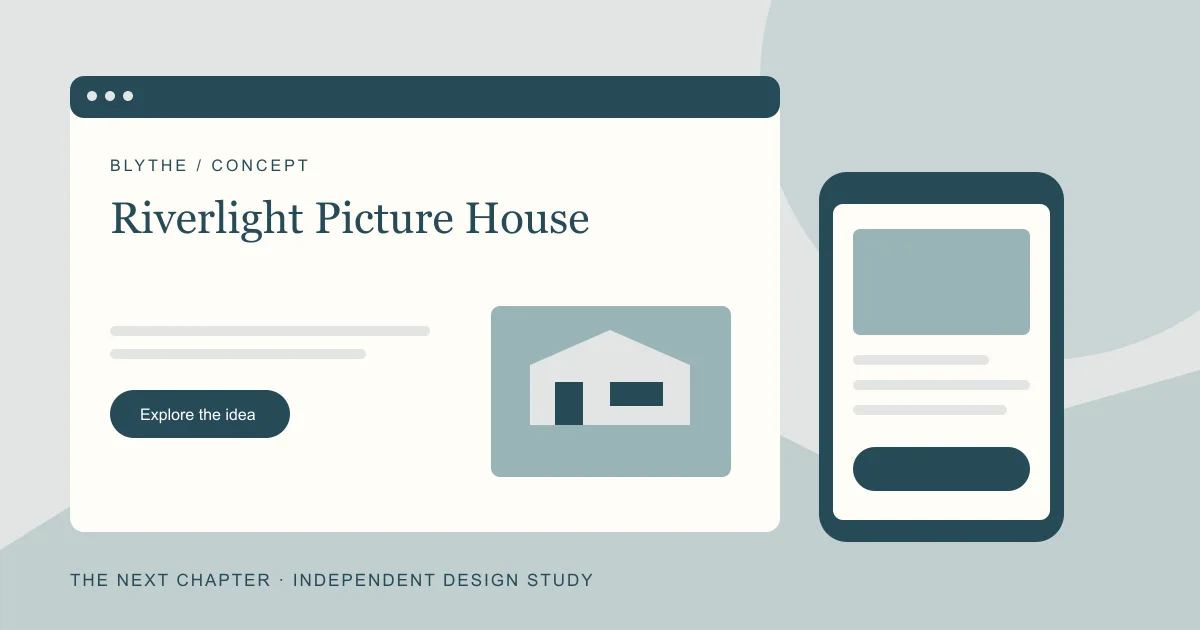
EXPLORE THE WEBSITE CONCEPT
Riverlight Picture House
A proposed digital front door built around a customer task in Blythe.
A local entertainment site should make the next dated event easier to find than its brand history.
The opening screen would identify the offer, its real location or service area, and the action a customer can actually take. Any hours, prices, availability, or promises would come from the owner before launch.
See how I would check it ↓Date-first screening calendar with individual event pages and clearly separated proposed venue information.
Give the customer a clear route into this task, explain what is needed, and confirm what happened. A request must never look like a confirmed purchase, appointment, or reservation when it is only an inquiry.
See where it fits in the launch week ↓What would tell us it is useful?
Successful selection of an event date and ticket-option handoff in a usability test.
This is a measurement plan. No traffic, ranking, sales, or conversion results have been collected for this fictional concept.
The first seven days, with a defined finish line
I would scope the first release around the customer task above. The schedule assumes the owner has supplied accurate content, approved the offer, and provided the access needed to launch. Custom integrations or a complex application need their own estimate.
- Day 1 · Establish the facts. Confirm the new concept's offer and audience in Blythe. Collect permission to use its photos and wording. Keep the historical business separate from the new brand.
- Day 2 · Map the decision. Turn the design question into an outline: A local entertainment site should make the next dated event easier to find than its brand history. Identify what the visitor needs before they act.
- Day 3 · Build the essential pages. Draft a useful home page, an offer or service page, and contact information. Show the Riverlight Picture House identity consistently, with a readable mobile layout.
- Day 4 · Make the task understandable. Prototype and test the proposed feature: Date-first screening calendar with individual event pages and clearly separated proposed venue information. Use clear instructions, validation, and an honest completion state.
- Day 5 · Check the basics. Test keyboard use, labels, readable text, image sizes, working links, and a phone-sized screen. Check page titles, canonicals, and crawlable navigation.
- Day 6 · Introduce the real site to Google. Verify the appropriate Search Console property, check the sitemap, and inspect an important URL. Requesting a crawl is not a guarantee of indexing.
- Day 7 · Launch and write down the baseline. Complete the main task once from beginning to end, confirm who receives any request, and record what will be measured next: Successful selection of an event date and ticket-option handoff in a usability test.
This is a proposed launch plan for a digital foundation. It does not reopen the historical business, create demand, or promise a particular position in search. Read the detailed seven-day launch guide.
The test matters as much as the layout
During the seven-day build, I would test a visitor choosing a date, comparing two sample screenings, and reaching the correct demonstration ticket handoff. I would also test an event that has already ended, because an old page should not imply a new ticket is available. The result would be a repeatable publishing process for dated events. Real attendance, ticket revenue, and organic-search growth would require an operating venue and later observation.
Successful selection of an event date and ticket-option handoff in a usability test.
A professional web designer should be able to explain these tradeoffs. If the task needs changing data, rules, or a more complex workflow, a software engineer or web application developer may be part of the build. The useful question is whether the work makes the customer's next step clearer and the business's follow-through dependable.
Carry the idea into your own next chapter
The repeatable part is the process: establish the facts, identify a real customer task, build the smallest complete version, test it, and measure what happens. The details should change with the business. For Blythe, the lesson in this study is: A local entertainment site should make the next dated event easier to find than its brand history.
Start with Google Search Console · Understand sitemaps and indexing · Read the regional study.