
I would design Courtyard & Copper around the decisions that come before a La Quinta dinner reservation. This fictional restaurant would offer a few clearly differentiated occasions: a relaxed lunch, an evening meal, or a larger gathering. The visitor should understand which option fits before leaving the website for a booking service. My aim would be a useful invitation that gives enough context for the next click to make sense.
This is an independent educational study, not a client project or reopening announcement. The concept below is fictional. It shows proposed work, not measured business results.
The part we can put on the record
GAYOT marks Hog’s Breath Inn La Quinta at 78065 Main Street closed. THIS RESTAURANT IS CLOSED Hog’s Breath Inn La Quinta — GAYOT.
The guide supplies no exact closure date. Its listing concerns the former La Quinta location, separately from the original Carmel restaurant; the fictional concept is unrelated.
A closure or change of use does not tell us whether a website was good or bad. I am not attributing this history to SEO or claiming a different site would have changed it. The useful exercise is to take a customer task from this type of business and work through a fresh design.
The question I would design around
The dining page would pair each proposed meal period with its relevant sample menu and an explanation of the booking process. A group inquiry would not masquerade as an instantly confirmed table. I would also make any external handoff obvious, because the destination and the status of a booking matter more than the appearance of a familiar button. The design could remain elegant while still speaking plainly.
The proposed feature: An occasion-led dining page with lunch, evening, and group options plus a transparent external reservation handoff.
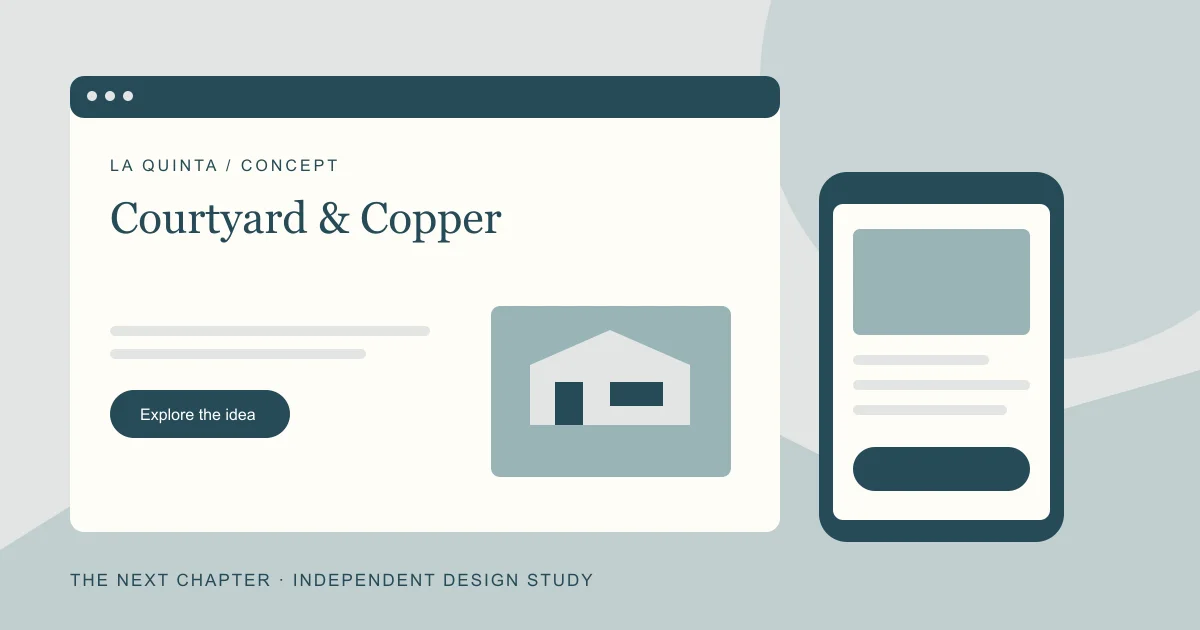
EXPLORE THE WEBSITE CONCEPT
Courtyard & Copper
A proposed digital front door built around a customer task in La Quinta.
Let a visitor compare dining occasions and confirm reservation requirements before leaving for a booking service.
The opening screen would identify the offer, its real location or service area, and the action a customer can actually take. Any hours, prices, availability, or promises would come from the owner before launch.
See how I would check it ↓An occasion-led dining page with lunch, evening, and group options plus a transparent external reservation handoff.
Give the customer a clear route into this task, explain what is needed, and confirm what happened. A request must never look like a confirmed purchase, appointment, or reservation when it is only an inquiry.
See where it fits in the launch week ↓What would tell us it is useful?
Visitors choose the right proposed meal period and understand whether their next action requests or confirms a booking.
This is a measurement plan. No traffic, ranking, sales, or conversion results have been collected for this fictional concept.
The first seven days, with a defined finish line
I would scope the first release around the customer task above. The schedule assumes the owner has supplied accurate content, approved the offer, and provided the access needed to launch. Custom integrations or a complex application need their own estimate.
- Day 1 · Establish the facts. Confirm the new concept's offer and audience in La Quinta. Collect permission to use its photos and wording. Keep the historical business separate from the new brand.
- Day 2 · Map the decision. Turn the design question into an outline: Let a visitor compare dining occasions and confirm reservation requirements before leaving for a booking service. Identify what the visitor needs before they act.
- Day 3 · Build the essential pages. Draft a useful home page, an offer or service page, and contact information. Show the Courtyard & Copper identity consistently, with a readable mobile layout.
- Day 4 · Make the task understandable. Prototype and test the proposed feature: An occasion-led dining page with lunch, evening, and group options plus a transparent external reservation handoff. Use clear instructions, validation, and an honest completion state.
- Day 5 · Check the basics. Test keyboard use, labels, readable text, image sizes, working links, and a phone-sized screen. Check page titles, canonicals, and crawlable navigation.
- Day 6 · Introduce the real site to Google. Verify the appropriate Search Console property, check the sitemap, and inspect an important URL. Requesting a crawl is not a guarantee of indexing.
- Day 7 · Launch and write down the baseline. Complete the main task once from beginning to end, confirm who receives any request, and record what will be measured next: Visitors choose the right proposed meal period and understand whether their next action requests or confirms a booking.
This is a proposed launch plan for a digital foundation. It does not reopen the historical business, create demand, or promise a particular position in search. Read the detailed seven-day launch guide.
The test matters as much as the layout
By day seven, I would test a visitor planning lunch and another organizing a group evening. Each should arrive at the appropriate demonstration action and explain whether it represents a request or a confirmation. I would measure those task outcomes and revise unclear wording. This would show how a professional web designer can reduce uncertainty in a reservation journey, without inventing reservations, endorsing a real venue, or promising business results.
Visitors choose the right proposed meal period and understand whether their next action requests or confirms a booking.
A professional web designer should be able to explain these tradeoffs. If the task needs changing data, rules, or a more complex workflow, a software engineer or web application developer may be part of the build. The useful question is whether the work makes the customer's next step clearer and the business's follow-through dependable.
Carry the idea into your own next chapter
The repeatable part is the process: establish the facts, identify a real customer task, build the smallest complete version, test it, and measure what happens. The details should change with the business. For La Quinta, the lesson in this study is: Let a visitor compare dining occasions and confirm reservation requirements before leaving for a booking service.
Start with Google Search Console · Understand sitemaps and indexing · Read the regional study.