
A website can explain a business beautifully and still leave the team copying the same information between an inbox, a spreadsheet and a notebook. When I plan custom business software, I start with that handoff: what should happen to the information after a customer provides it?
Start with one repeatable piece of work
Consider an illustrative Beaumont service company receiving estimate requests. A customer supplies their contact details and a description of the job. Someone checks the service area, assigns a team member, follows up and records the outcome. Each step has an owner, an information requirement and a status.
The useful software question is specific: where is that process becoming difficult to manage? Perhaps the same customer has several disconnected records. Perhaps the team cannot tell whether a request has been answered. Perhaps an estimate is approved but never reaches the person scheduling the work.
Custom software development can address those gaps with a shared record, clearer stages and an interface designed around the team’s actual tasks. The first version should prove one useful workflow before expanding into every department.
What Raphael’s experience builder demonstrates
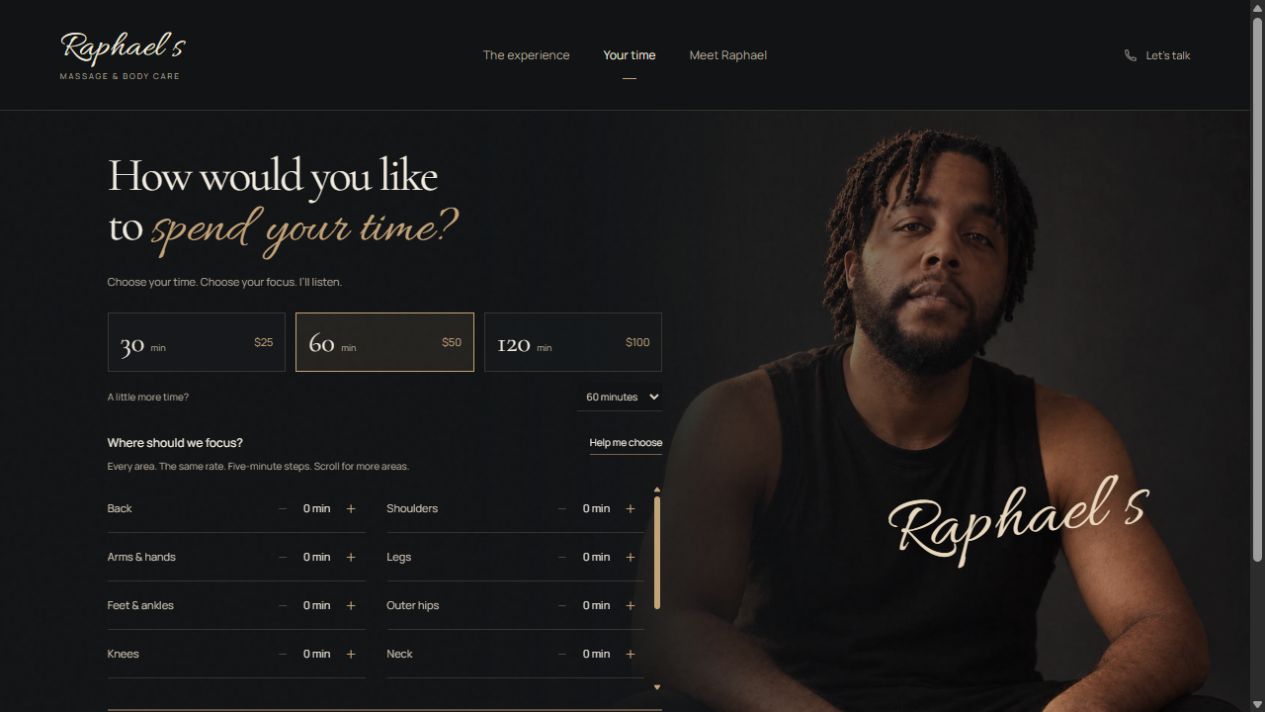
On Raphael’s Massage & Body Care, visitors can choose time and focus preferences before requesting an appointment. Their choices are summarized before the form asks for contact information. The design lets a visitor explain what they want in a structured way.
That is a small but useful example of software thinking within web design. A duration is a value with a limited set of choices. Focus preferences relate to that duration. A displayed price should remain consistent with the selection. The request must communicate that a preferred time is not yet a confirmed reservation.
The public flow demonstrates those interface decisions. It does not establish that the site includes live calendar inventory, a CRM integration or automated staff scheduling. Those would be separate features to specify and verify.
Design the records before decorating the dashboard
A dashboard becomes useful when its records have clear meanings. A customer, an inquiry, an appointment and a payment are related, but they are different things. One customer can make several inquiries. An inquiry can remain open without becoming an appointment. A requested appointment can change before it is confirmed.
For a Riverside company, a sensible first data model might connect a customer to their inquiries, give each inquiry a responsible team member and record its status changes. The interface can then answer a practical question: which requests need attention today?
This is an illustrative workflow, not a claim about a particular client’s installation. Its value comes from agreeing on the rules with the people who do the work.
Sometimes the best solution is an integration
A company may already have an accounting system, booking platform or CRM that works well. Replacing it could create more work than it solves. An integration, a simpler intake form or a focused internal screen may be enough.
I would compare the recurring manual effort with the cost of building and maintaining the change. For example, if a team spends five hours a week re-entering inquiries, a four-week baseline records twenty hours of that activity. A pilot can then measure whether the new process actually reduces that work. That is a measurement plan, not a promised saving.
Inland Empire businesses have different operating needs. An Ontario distributor, a Redlands professional practice and a Banning service team should not receive the same custom software specification just because each wants a dashboard.
What belongs in a useful first release
- One defined workflow: agree on where work starts, who handles it and what completion means.
- Clear access: each role should see and change the information needed for its work.
- Reliable records: validate important fields and make failed saves visible.
- A recovery plan: define backups, exports and what happens if an integration becomes unavailable.
- A handoff: document everyday use, ownership and support responsibilities.
These decisions are where data architecture, interface design and software development meet. My work with WDM’s website and lead-management tools and Data Architect Hire reflects that interest in connecting the visible page to useful business information.
If your company is outgrowing a patchwork of forms and spreadsheets, bring one example of a difficult handoff. We can use it to discuss custom business software, business integrations or a focused web application. Start with the process you want to improve.