
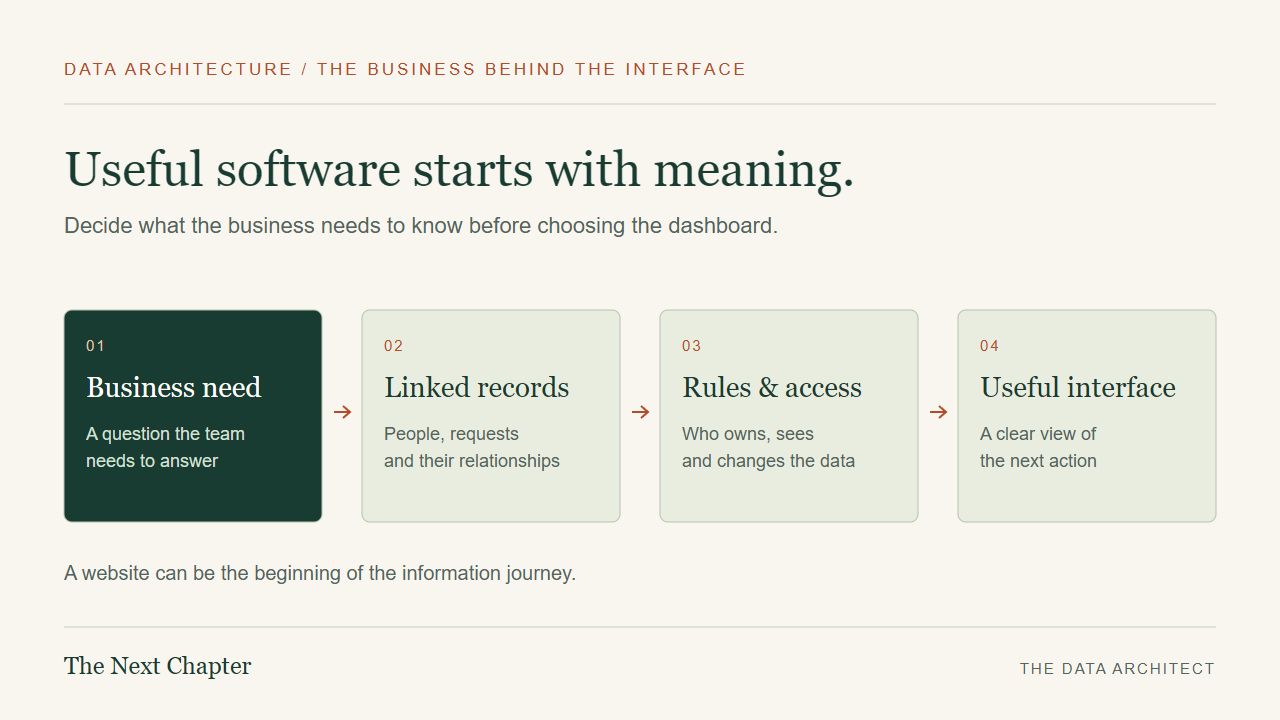
The name The Data Architect describes the part of this work that interests me most: understanding how information should fit together so a business can use it. A website may be where a customer first meets that business. The information collected there often has a much longer journey.
What a data architect does
A data architect plans how an organization’s information is structured, connected, stored, accessed and used. The work begins with business requirements and turns them into data models, system relationships and rules that guide implementation.
IBM’s overview of data architecture describes the discipline in terms of managing information through its movement and use, with design driven by business needs. In a large organization, that can involve enterprise models, integration patterns, governance and analytics platforms. In a smaller company, the same questions can appear in the relationship between a customer form, a CRM and an operational dashboard.
The scale changes. The need to define what a record means, who owns it and how it moves between systems remains.
How the role relates to web design and software development
A web designer focuses on how people understand and use an interface. A software developer implements behavior and integrations. A database administrator operates and maintains databases. A data architect concentrates on the structure and relationships that allow information to support the business.
Those responsibilities can overlap, particularly in a small development practice. Designing a beautiful inquiry form is interface work. Implementing its validation and storage is development work. Deciding how the inquiry relates to a customer, an assigned employee and a follow-up history is data architecture work.
A useful project makes room for all three questions: can the person use it, does the software behave correctly, and does the information remain meaningful after it is saved?
How that connects to my work as The Data Architect
I’m Shayne Brown, the person behind The Data Architect. My work brings web design and custom business software together. I build interfaces people can use and think through the records and workflows those interfaces support.
WDM brings website management and lead-management work into the same product environment. Data Architect Hire connects a business’s hiring page with applications, resumes, review notes and progress tracking. These are practical examples of organizing business information around a task.
Consider the hiring flow. A business owns a hiring page. An applicant sends information to that business. A submission moves through review statuses, and its resume remains connected to the appropriate record. The relationship between those pieces and the access boundaries around them are architectural decisions as well as coding decisions.
That is the context in which I describe my work as data architecture: planning and building the information structures behind usable business systems. The name is supported by the work and the decisions inside it, rather than by the appearance of a dashboard alone.
A small business example makes the idea concrete
Imagine a Banning service company receiving three requests from the same customer over several months. If each request is saved as an unrelated message, a team member has to reconstruct the history manually. A more useful model gives the customer one record and connects each inquiry to it.
Now add a responsible employee, a status and a history of follow-ups. The business can ask which inquiries are still open and who is handling them. If a website, CRM and reporting screen share those definitions, the information is easier to use consistently.
This is an illustrative example, not a reported client result. The same planning approach could support a Beaumont appointment business, a Riverside professional service or a staffing agency coordinating job orders across the Inland Empire.
My training and the evidence I want you to look at
I am a Merit America graduate and hold the Google IT Support Professional Certificate. Verify my certificate on Coursera, completed November 25, 2023. That training is part of my technical foundation. It is an IT support credential, not a separate certification in enterprise data architecture.
For a project decision, I want you to look at relevant work, clear requirements and the way I explain the system. Ask how the records connect, what happens when information is incomplete, who can access it, how it can be exported and what will be tested before launch.
Those questions give us a much better conversation than a title on its own. They also help establish which parts of a project I can deliver directly and which requirements need a specialist or a separate phase.
When your company needs this kind of planning
Data architecture becomes useful when staff repeatedly copy information, records disagree, a customer’s history is hard to find or no one can identify the next owner of a task. It also matters before an integration or automation: connecting two systems will not resolve conflicting definitions by itself.
You may need a new application. You may need a better data model inside an existing one. Sometimes the right first step is simply documenting the current workflow and deciding which system is responsible for each piece of information.
At The Data Architect, that conversation can lead to web design, custom business software, integrations and workflow automation, or a focused staffing agency system. Bring me the business problem you want to make clearer. We can start with the information and build the right interface around it.