
An AI company can attract extraordinary investment while a small business is still asking a very ordinary question: will this help my team do useful work? Anthropic, the company behind Claude, is a good example. The investor headlines are worth understanding. Turning them into a purchasing decision takes a different kind of evidence.
What the announcements actually say
On May 28, 2026, Anthropic announced a $65 billion Series H funding round at a $965 billion post-money valuation, led by Altimeter Capital, Dragoneer, Greenoaks and Sequoia Capital. The company said the funding would support research, computing capacity and products. These are company-reported figures from its funding announcement; the May round should not be mistaken for a new October investment.
A more recent announcement, dated October 18, 2026, describes an Anthropic Public Benefit Fund. The proposed initial commitment is 5% of the company’s shares, subject to stockholder approval, with a mechanism for additional allocations as its value grows. The announcement discusses potential uses rather than a completed distribution to beneficiaries.
Funding and governance describe the organization behind a product. They do not establish whether a particular feature is accurate enough, affordable enough or appropriate for your company’s information. That is the distinction a business buyer needs to keep.
Investment is a signal, not an acceptance test
Large investors are making a judgment about a company and its prospects. Your business is making a judgment about a particular workflow. Those judgments can involve very different requirements.
A service business in Beaumont might need help turning approved job notes into a consistent draft. A distributor in San Bernardino might want a clearer explanation of an inventory exception. A Yucaipa office might need a searchable set of internal procedures. These are illustrative uses to evaluate, not results we are claiming for existing clients.
For each one, the practical questions are the same: what information goes in, what output comes back, who checks it, and what happens when the answer is wrong? A fluent answer still needs to be checked against the source.
Choose one narrow pilot with a clear finish line
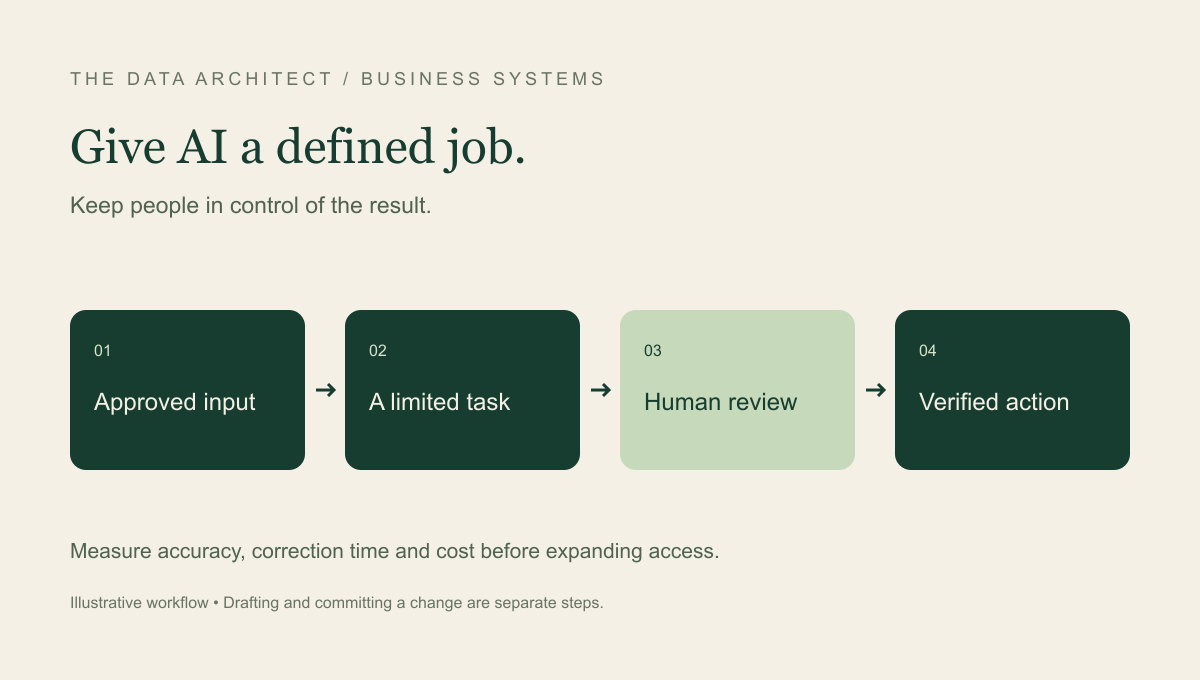
Start with a repetitive task whose output a knowledgeable person can review quickly. For example, produce a first draft of a customer-facing explanation from a short, approved service note. Keep sending the message as a separate human action.
- Record the current process. Time the work, including corrections and handoffs. Save representative examples with confidential details removed.
- Define an acceptable result. List the required facts, prohibited claims, tone and format. Include examples where the right response is to ask for clarification.
- Test ordinary and difficult inputs. Try missing information, conflicting dates and a request outside the task. Check whether the output invents an answer.
- Count review time. A fast first draft is not a saving if correcting it takes longer than doing the original task.
- Set a stop rule. Pause the pilot when errors, costs or access requirements exceed the agreed limit.
This produces evidence your team can discuss: time per completed task, correction frequency and whether the final output meets the requirements. It is much more useful than a demonstration using one carefully selected example.
Keep the system of record in charge
In a custom CRM, the customer record should remain authoritative. In a staffing system, application and scheduling records need defined permissions and an audit trail. An AI-generated summary can assist a person without silently rewriting the underlying record.
A sensible design separates reading, drafting, approving and committing a change. Give an integration only the access required for its agreed task. Validate structured output before using it, show the supporting source when possible, and keep a recoverable history of authorized changes.
Begin with a test environment and synthetic records. Actions such as sending an email, changing an appointment or updating an invoice should have an explicit approval step while the workflow is being evaluated. A failed model call also needs a normal fallback so the business can continue working.
Check the product terms and operating costs
Review the current terms for the exact Claude product and plan you intend to use. A consumer subscription, a team workspace and an API integration can have different controls and commercial arrangements. Check data handling, retention, access management and available contractual terms before providing company information; do not assume one plan’s settings apply to another.
Estimate the whole operating cost: subscription or usage fees, development, monitoring, review time and maintenance when a model or integration changes. Agree on a spending limit and who can approve an increase. Keep a sample evaluation set so later changes can be checked against the same expectations.
For a regulated workflow or sensitive records, involve the people responsible for the company’s privacy, security and legal requirements before choosing an implementation. A general-purpose demonstration is not evidence that those requirements have been met.
Connect the technology to a real business need
My approach at The Data Architect is to begin with the process and the people using it. Sometimes the best first improvement is a clearer form, a reliable integration or a better search interface. An AI component becomes useful when it solves a defined part of that problem and its output can be evaluated.
If your Inland Empire team is considering Claude or another AI service, bring one example of the work, the systems involved, the people affected and the result you want. Our custom business software guide explains how to turn that into a manageable scope. The company inquiry form gives us a practical starting point.
Published October 26, 2026. Announcement facts are attributed above; workflow recommendations are The Data Architect’s analysis. This is an independent explanation, with no claimed affiliation or endorsement from Anthropic or its investors.